 Add to Chrome
 Add to Firefox
 Add to Edge
Helicase: Uncertainty-Guided Supply Chain Knowledge Graph Construction with Autonomous Multi-Agent LLMs
May 26, 2026
LLM-based multi-agent systems have been widely adopted for knowledge retrieval and report generation, synthesizing known information through web search and textual reasoning. However, many critical information tasks in supply chains are not simple one-shot queries: they are structural inference problems requiring multi-hop reasoning across complex, fragmented web resources. Questions such as \textit{``Which Tesla components use lithium from Australian mines?''} have no answer in any single document; answers must be computationally synthesized through the autonomous construction and analysis of dynamic knowledge graphs assembled from fragmented, heterogeneous sources. Moreover, such discovery processes must be uncertainty-aware: decisions depend not only on answers but on calibrated confidence in their reliability, traceable to source quality and reasoning consistency. To address this capability gap, we propose \textit{Helicase}, an autonomous multi-agent LLM system for uncertainty-guided supply chain knowledge graph construction. \textit{Helicase} decomposes high-level supply-chain queries into executable investigation plans, coordinates specialized web-search, reasoning, and coding agents through iterative verification loops, and incrementally constructs query-specific supply chain knowledge graphs with per-fact uncertainty annotations. Its three-layer uncertainty framework tracks uncertainty at the action, trajectory, and memory layers, enabling both structural inference and calibrated confidence assessment. To evaluate autonomous reasoning across the full complexity spectrum, we introduce SCQA (Supply Chain Query Assessment), a benchmark of 80 supply chain queries organized into four quadrants spanning single-hop to multi-hop inference under both high and low data visibility.

EmoDistill: Offline Emotion Skill Distillation for Language Model Agents in Adversarial Negotiation
May 26, 2026Post-trained LLMs are often optimized to align responses with human preferences, making them safe, polite, and conversationally appropriate. In adversarial negotiation, however, this alignment can become a vulnerability: emotionally framed language may steer agents toward the counterparty's interests. Using GoEmotions-based affective prompting, we show that emotion substantially shifts negotiation outcomes, suggesting that emotion is a strategic action channel rather than a surface style. Thus, we introduce \textbf{EmoDistill}, an offline framework for distilling emotional negotiation skills into language model agents. EmoDistill decomposes emotional strategy into emotion selection and emotion expression: an Implicit Q-Learning (IQL) selector learns \emph{which} emotion to express, while a Low-Rank Adaptation (LoRA)-based policy learns \emph{how} to express it through Supervised Fine-Tuning (SFT) and Judge Policy Optimization (JPO). Across four emotion-sensitive, high-stakes negotiation domains, SLM policies trained under the EmoDistill framework achieve the highest utility, outperforming vanilla SLM/LLM baselines and IQL-only emotion selection. Ablations show that emotion conditioning is essential, and transfer studies demonstrate generalization across domains, unseen counterparties, and trained-vs-trained tournaments. Overall, EmoDistill learns skills from offline agent-to-agent interactions, avoiding costly online negotiation during training.
Generating Logically Consistent Synthetic Supply Chain Data with LLM-Driven Knowledge Graph Reasoning
May 26, 2026Synthetic data offers a promising solution to two persistent barriers in supply chain analytics: data scarcity and data privacy. However, for synthetic data to support operational simulation and decision-making, it must do more than reproduce the statistical distributions of real records, and also preserve the \emph{operational logic} that governs supply chain processes, including the temporal orderings, mathematical dependencies, hierarchical taxonomies, and conditional rules that make a record operationally plausible. We consider this logic as the ``physics'' of supply chain data. Existing tabular generative models are primarily optimized for distributional fidelity and downstream predictive utility, and therefore often generate records that appear statistically realistic but violate fundamental operational constraints. This paper introduces \textbf{\textit{TabKG}}, a knowledge-graph-guided framework for logically consistent synthetic supply chain tabular data generation. TabKG constructs a \textbf{\textit{Column Relationship Knowledge Graph (CR-KG)}} to represent data operational dependencies. It uses a multi-LLM ensemble with majority voting to propose candidate relationships from column metadata, validates these relationships against real data to remove hallucinated or unsupported edges, and then uses the validated CR-KG to guide generation. Specifically, TabKG compresses the original table into independent columns, generates these columns using a latent diffusion model, and deterministically reconstructs dependent columns according to the validated relationships, enforcing logical consistency by construction with respect to the discovered operational rules.
VeriTrace: Evolving Mental Models for Deep Research Agents
May 25, 2026Deep research agents face vast, interdependent, and pervasively uncertain information. Existing systems explore what evolving intermediate representations should look like, but leave their evolution to the LLM's implicit reasoning. Without explicit regulation, the intermediate layer is easily contaminated by mixed-quality information and propagates errors along its dependencies, so model scale often ends up substituting for absent regulation. We argue that an agent's mental model should instead evolve through explicit feedback that continuously aligns task understanding with reality, and identify three regulatory loops: interpretive update, deviation feedback, and schema revision. We realise this in VeriTrace, a cognitive-graph framework that explicitly implements the three loops. Using matched Qwen3.5-27B backbones, VeriTrace improves over the strongest matched baseline by 4.22 pp on DeepResearch Bench (DRB) Insight (1.49 pp Overall) and by 5.9 pp Overall win rate on DeepConsult. With Config-DeepSeek, it achieves the strongest reproducible open-source result on DRB.
Self-Policy Distillation via Capability-Selective Subspace Projection
May 21, 2026Self-distillation bootstraps large language models (LLMs) by training on their own generations. However, existing methods either rely on external signals to curate self-generated outputs (e.g., correctness filtering, execution feedback, and reward search), which are costly and unavailable for the best-performing frontier models, or skip curation entirely and train on all raw outputs, an approach that is often domain-specific and hard to generalize. Both also share a deeper weakness that self-generated outputs entangle task-relevant capability with others, such as stylistic patterns, formatting artifacts, and model-specific errors, diluting the signal for the specific capability one aims to improve. In this paper, we propose Self-Policy Distillation (SPD), which achieves generalizable, capability selective without any external signal. Specifically, SPD extracts a low-rank capability subspace from the model's own gradients on correctness-defining tokens, projects key-value (KV) activations into this subspace during self-generation, and fine-tunes on the resulting raw outputs with standard next-token prediction loss. Through extensive experiments across code generation, mathematical reasoning, and multiple-choice QA, we show that SPD achieves up to 13% improvement over state-of-the-art self-distillation methods without external signals and up to 16% improvement over pre-trained baselines. Notably, SPD demonstrates superior generalizability, achieving 15% better performance under out-of-domain generalization settings.
Self-Improving Tabular Language Models via Iterative Group Alignment
Apr 21, 2026While language models have been adapted for tabular data generation, two fundamental limitations remain: (1) static fine-tuning produces models that cannot learn from their own generated samples and adapt to self-correct, and (2) autoregressive objectives preserve local token coherence but neglect global statistical properties, degrading tabular quality. Reinforcement learning offers a potential solution but requires designing reward functions that balance competing objectives -- impractical for tabular data. To fill the gap, we introduce TabGRAA (Tabular Group-Relative Advantage Alignment), the first self-improving framework for tabular data generation via automated feedback. At each iteration, TabGRAA uses an \emph{automated quality signal} -- such as a two-sample distinguishability classifier or a distance-based reward -- to partition newly generated samples into high- and low-quality groups, then optimizes a group-relative advantage objective that reinforces realistic patterns while penalizing artifacts. The specific signal is a modular choice rather than a fixed component of the framework. This establishes a virtuous feedback cycle, where the quality signal is re-computed against newly \emph{generated synthetic} samples at each round; the language model is only fine-tuned on these self-generated signals, so no additional real record is exposed during alignment, mitigating data-leakage risk beyond the initial supervised fine-tuning. Experiments show TabGRAA outperforms existing methods in fidelity, utility, and privacy, while matching or exceeding diffusion-based synthesizers, advancing tabular synthesis from static statistical replication to dynamic, self-improving generation.
Hidden in Plain Sight: Visual-to-Symbolic Analytical Solution Inference from Field Visualizations
Apr 10, 2026Recovering analytical solutions of physical fields from visual observations is a fundamental yet underexplored capability for AI-assisted scientific reasoning. We study visual-to-symbolic analytical solution inference (ViSA) for two-dimensional linear steady-state fields: given field visualizations (and first-order derivatives) plus minimal auxiliary metadata, the model must output a single executable SymPy expression with fully instantiated numeric constants. We introduce ViSA-R2 and align it with a self-verifying, solution-centric chain-of-thought pipeline that follows a physicist-like pathway: structural pattern recognition solution-family (ansatz) hypothesis parameter derivation consistency verification. We also release ViSA-Bench, a VLM-ready synthetic benchmark covering 30 linear steady-state scenarios with verifiable analytical/symbolic annotations, and evaluate predictions by numerical accuracy, expression-structure similarity, and character-level accuracy. Using an 8B open-weight Qwen3-VL backbone, ViSA-R2 outperforms strong open-source baselines and the evaluated closed-source frontier VLMs under a standardized protocol.
EmoMAS: Emotion-Aware Multi-Agent System for High-Stakes Edge-Deployable Negotiation with Bayesian Orchestration
Apr 08, 2026Large language models (LLMs) has been widely used for automated negotiation, but their high computational cost and privacy risks limit deployment in privacy-sensitive, on-device settings such as mobile assistants or rescue robots. Small language models (SLMs) offer a viable alternative, yet struggle with the complex emotional dynamics of high-stakes negotiation. We introduces EmoMAS, a Bayesian multi-agent framework that transforms emotional decision-making from reactive to strategic. EmoMAS leverages a Bayesian orchestrator to coordinate three specialized agents: game-theoretic, reinforcement learning, and psychological coherence models. The system fuses their real-time insights to optimize emotional state transitions while continuously updating agent reliability based on negotiation feedback. This mixture-of-agents architecture enables online strategy learning without pre-training. We further introduce four high-stakes, edge-deployable negotiation benchmarks across debt, healthcare, emergency response, and educational domains. Through extensive agent-to-agent simulations across all benchmarks, both SLMs and LLMs equipped with EmoMAS consistently surpass all baseline models in negotiation performance while balancing ethical behavior. These results show that strategic emotional intelligence is also the key driver of negotiation success. By treating emotional expression as a strategic variable within a Bayesian multi-agent optimization framework, EmoMAS establishes a new paradigm for effective, private, and adaptive negotiation AI suitable for high-stakes edge deployment.
AI-Supervisor: Autonomous AI Research Supervision via a Persistent Research World Model
Mar 25, 2026Existing automated research systems operate as stateless, linear pipelines, generating outputs without maintaining a persistent understanding of the research landscape. They process papers sequentially, propose ideas without structured gap analysis, and lack mechanisms for agents to verify or refine each other's findings. We present AutoProf (Autonomous Professor), a multi-agent orchestration framework where specialized agents provide end-to-end AI research supervision driven by human interests, from literature review through gap discovery, method development, evaluation, and paper writing, via autonomous exploration and self-correcting updates. Unlike sequential pipelines, AutoProf maintains a continuously evolving Research World Model implemented as a Knowledge Graph, capturing methods, benchmarks, limitations, and unexplored gaps as shared memory across agents. The framework introduces three contributions: first, structured gap discovery that decomposes methods into modules, evaluates them across benchmarks, and identifies module-level gaps; second, self-correcting discovery loops that analyze why modules succeed or fail, detect benchmark biases, and assess evaluation adequacy; third, self-improving development loops using cross-domain mechanism search to iteratively address failing components. All agents operate under a consensus mechanism where findings are validated before being committed to the shared model. The framework is model-agnostic, supports mainstream large language models, and scales elastically with token budget from lightweight exploration to full-scale investigation.
EQ-Negotiator: Dynamic Emotional Personas Empower Small Language Models for Edge-Deployable Credit Negotiation
Nov 05, 2025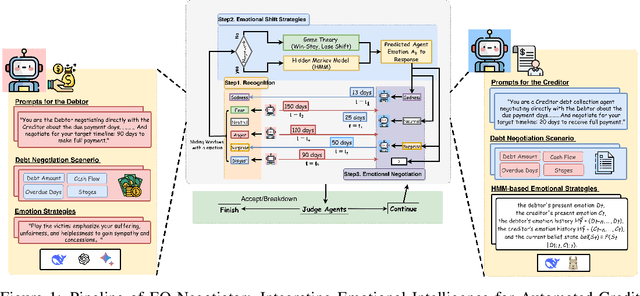
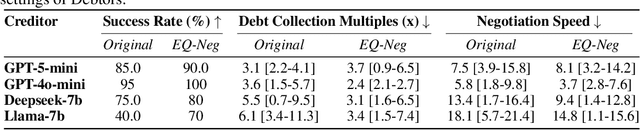
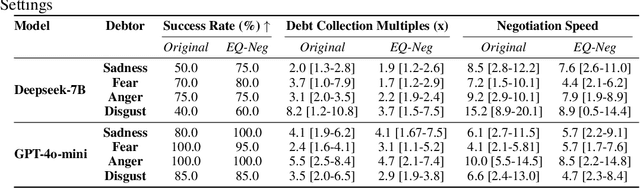
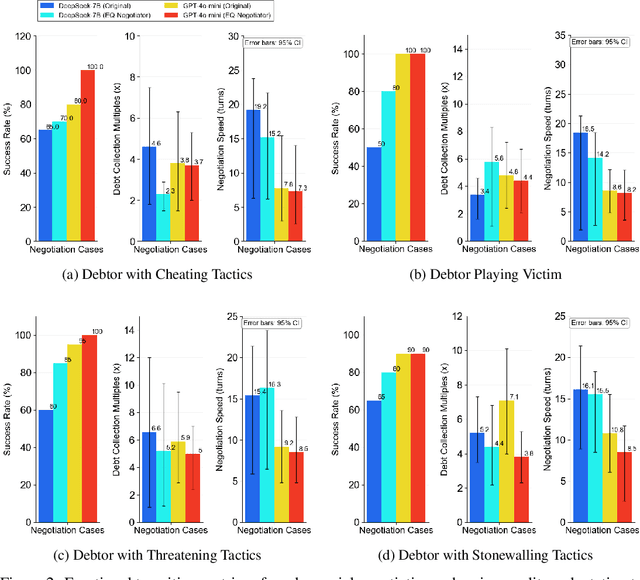
The deployment of large language models (LLMs) in automated negotiation has set a high performance benchmark, but their computational cost and data privacy requirements render them unsuitable for many privacy-sensitive, on-device applications such as mobile assistants, embodied AI agents or private client interactions. While small language models (SLMs) offer a practical alternative, they suffer from a significant performance gap compared to LLMs in playing emotionally charged complex personas, especially for credit negotiation. This paper introduces EQ-Negotiator, a novel framework that bridges this capability gap using emotional personas. Its core is a reasoning system that integrates game theory with a Hidden Markov Model(HMM) to learn and track debtor emotional states online, without pre-training. This allows EQ-Negotiator to equip SLMs with the strategic intelligence to counter manipulation while de-escalating conflict and upholding ethical standards. Through extensive agent-to-agent simulations across diverse credit negotiation scenarios, including adversarial debtor strategies like cheating, threatening, and playing the victim, we show that a 7B parameter language model with EQ-Negotiator achieves better debt recovery and negotiation efficiency than baseline LLMs more than 10 times its size. This work advances persona modeling from descriptive character profiles to dynamic emotional architectures that operate within privacy constraints. Besides, this paper establishes that strategic emotional intelligence, not raw model scale, is the critical factor for success in automated negotiation, paving the way for effective, ethical, and privacy-preserving AI negotiators that can operate on the edge.